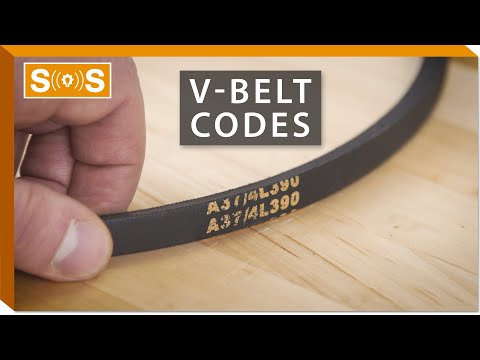
V-Belt Code Guide
The Ultimate V-Belt Code Guide: How to Read and Measure Appliance Belts
If your washing machine is refusing to spin, your dryer is tumbling silently without moving, or your air conditioner blower has gone dead, there is a high probability that a worn-out V-belt is the culprit. V-belts are the unsung heroes of household appliances, transferring rotational power from the motor to drums, pulleys, and fans.
However, when you go to order a replacement, you are often confronted with a confusing string of letters and numbers stamped on the old belt—such as "4L300," "A30," or "3VX320." Understanding this code is the difference between a quick, successful repair and a frustrating return process. In this guide, we will break down how to decode V-belt part numbers and how to measure your belt if the text has worn off.
Decoding the Numbers: How to Read a V-Belt Code
Most V-belt codes contain two vital pieces of information: the cross-section (width and depth of the belt) and the length. However, different styles of belts use different systems. Let’s look at the three most common types of V-belts found in residential appliances.
1. Fractional Horsepower (FHP) Belts (The "L" Series)
These are incredibly common in light-duty household appliances like washing machines and blowers. They typically start with a number, followed by the letter "L", and then another number.
- The Prefix (e.g., 3L, 4L, 5L): This indicates the top width of the belt in eighths of an inch.
- 3L: 3/8 inch wide (and 7/32 inch thick)
- 4L: 1/2 inch wide (and 5/16 inch thick)
- 5L: 5/8 inch wide (and 3/8 inch thick)
- The Suffix (e.g., 300, 450): This represents the outside circumference (OC) of the belt in tenths of an inch. For example, "300" means 30.0 inches, while "455" means 45.5 inches.
- Example: A 4L300 belt is 1/2 inch wide with an outside circumference of exactly 30 inches.
2. Classical V-Belts (The "A, B, C" Series)
Often used in heavier-duty machinery, air compressors, and some older, heavy-duty washing machines, classical belts are designated by a letter followed by a number.
- The Letter (e.g., A, B, C): This indicates the width and thickness profile. An "A" belt is 1/2 inch wide; a "B" belt is 21/32 inch wide.
- The Number (e.g., 30, 55): Unlike FHP belts, this number represents the inside circumference (IC) of the belt in inches.
- Example: An A30 belt is 1/2 inch wide and has an inside circumference of 30 inches. (Note: Because it is measured by inside circumference, its outside circumference is actually about 32 inches. This is a common point of confusion when comparing "A" belts to "4L" belts!)
3. Cogged or Notched Belts (The "X" Series)
If you see an "X" in the code—such as AX, BX, or 3VX—this indicates a notched or cogged belt. These belts have grooves cut perpendicular to the belt's length on the inside track. These notches allow the belt to bend more easily around smaller pulleys and dissipate heat better, extending the lifespan of the belt in tight spaces.
How to Measure a V-Belt When the Code is Worn Off
Over years of rubbing against pulleys, the printed codes on appliance belts frequently wear off, leaving you with a blank black strip of rubber. Don't panic—you can easily determine the correct replacement belt by taking three simple measurements.
First, measure the Top Width. Use a ruler or caliper to measure across the widest, flat top side of the belt. If it measures 1/2 inch, you are looking at an "A" or "4L" profile. If it is 3/8 inch, it is a "3L" profile.
Second, measure the Outside Circumference. The most accurate way to do this is to take a flexible cloth measuring tape, wrap it tightly around the outside edge of the belt, and note the length. If you do not have a flexible measuring tape, you can lay a piece of string around the outside edge, cut it where it meets, and measure the string flat with a standard tape measure.
For a helpful visual demonstration on how to identify, measure, and match these belts correctly, check out this step-by-step V-Belt Identification Video Guide.
Important Differences: Inside vs. Outside Circumference
The single most common mistake DIYers make when ordering replacement belts is confusing inside circumference (IC) with outside circumference (OC).
As a rule of thumb:
- FHP Belts (3L, 4L, 5L) are always ordered by their outside circumference.
- Classical Belts (A, B, C) are ordered by their inside circumference.
If you mistakenly buy an "A30" belt thinking it is identical to a "4L300" belt because they are both 1/2 inch wide, you will find that the A30 belt is roughly 2 inches too long for your appliance's tensioner to handle. Always double-check which measurement standard your replacement part number uses!
Signs Your Appliance V-Belt Needs to Be Replaced
Belts don't always snap cleanly when they fail; they often degrade slowly over time. Keep an eye out for these warning signs that your belt is on its last legs:
- Squealing or Squeaking: A high-pitched noise during operation usually indicates the belt has stretched out, lost its grip, and is slipping on the pulleys.
- Cracking or Fraying: Unplug your appliance and inspect the belt. If you see dry-rot cracks, chunking, or loose threads along the edges, replace it immediately.
- Excessive Black Dust: Finding a pile of black rubber shavings inside your dryer or washing machine cabinet means the belt is actively disintegrating against the pulley.
- Slow or Weak Operation: If your washing machine tub barely spins under a load, the belt may be slipping under the weight.
Replacing a V-belt is one of the most cost-effective and straightforward repairs you can perform on your household appliances. By mastering the belt codes and taking precise measurements, you can confidently order the exact part you need to get your machine running smoothly again.