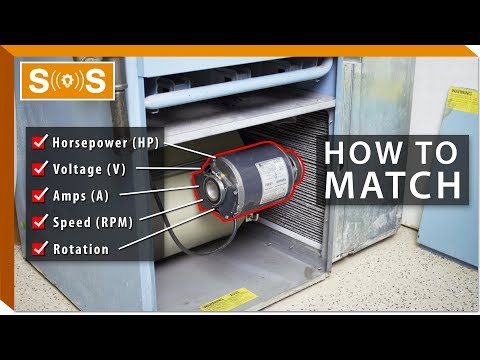
How to Match a Furnace Motor
How to Match a Furnace Motor: A Step-by-Step Guide
When the cold winter months roll in, your home relies heavily on your furnace to keep everyone warm and comfortable. At the heart of this heating system is the blower motor, which is responsible for circulating warm air through your ductwork. If this motor fails, your furnace will quickly grind to a halt. Replacing a furnace blower motor is a highly manageable DIY project, but success hinges on one crucial step: matching the replacement motor perfectly to your old one.
Installing an incorrect motor can lead to poor heating performance, electrical hazards, or premature system failure. To help you navigate this process, we have put together a comprehensive guide on how to read your motor's label and match its specifications accurately. If you want a visual walkthrough of this process, be sure to check out this step-by-step furnace motor identification video.
Step 1: Locate and Read the Motor Nameplate
Before you order any parts, you must locate the data plate (or nameplate) on the side of your existing furnace motor. This label is the "Rosetta Stone" of your motor; it contains all the electrical and physical specifications required to find an exact match. Over time, these labels can become dirty, faded, or scratched. If the label is dirty, gently wipe it clean with a dry cloth. If the label is completely missing or illegible, you will need to look up your furnace's model number to find the manufacturer's original parts list.
Step 2: Match the Electrical Specifications
When matching a furnace motor, electrical specifications are non-negotiable. Using a motor with the wrong electrical ratings can ruin the motor instantly or create a fire hazard. Pay close attention to these three key metrics:
- Voltage (V): Furnace motors typically run on either 115 Volts or 208-230 Volts. You must match the voltage exactly. A 115V motor hooked up to a 230V line will burn out immediately, while a 230V motor hooked up to 115V will not have enough power to start.
- Horsepower (HP): This measures the motor's strength. Common residential sizes include 1/4 HP, 1/3 HP, 1/2 HP, and 3/4 HP. Always match the horsepower rating. Under-sizing the motor will cause it to overheat and fail prematurely, while over-sizing can cause excessive airflow and system inefficiency.
- Amperage (FLA / Amps): Look for the "Full Load Amps" rating. While it is best to match the amperage exactly, your replacement motor's amp rating can be slightly higher than the original, but it should never be lower.
Step 3: Match the Physical and Performance Specs
Once the electrical requirements are met, you must ensure the new motor physically fits into your furnace housing and runs at the correct speed. Look for the following specifications on the label:
RPM and Speed Taps
RPM (Rotations Per Minute) indicates how fast the motor spins. Most standard furnace blower motors run at approximately 1075 RPM or 825 RPM. Your replacement motor must match the original RPM rating. Additionally, check the number of speeds. Older motors might be single-speed, while modern units are often multi-speed (typically 3-speed or 4-speed), allowing the furnace to adjust airflow for heating, cooling, and continuous fan modes.
Rotation Direction
A motor must spin in the correct direction to push air through your vents. Rotation is typically listed as CW (Clockwise) or CCW (Counter-Clockwise). However, manufacturers determine this direction either by looking at the shaft end (SE) or the lead/opposite shaft end (LE). Because of this potential confusion, many modern aftermarket replacement motors are "reversible," allowing you to change the rotation direction during installation by swapping two external wires.
Frame Size and Shaft Dimensions
The physical size of the motor is standardized by the NEMA (National Electrical Manufacturers Association) frame size. Most residential furnace blower motors are 48-frame (which has a motor body diameter of 5-5/8 inches). You must also measure the shaft diameter (usually 1/2 inch) and the shaft length to ensure it will securely mount to your blower wheel.
Step 4: Identify the Motor Type (PSC vs. ECM)
It is critical to determine whether you have a traditional PSC (Permanent Split Capacitor) motor or a modern ECM (Electronically Commutated Motor).
PSC motors are simpler, less expensive, and rely on a run capacitor to start and operate. If you are replacing a PSC motor, you should always buy a brand-new run capacitor that matches the microfarad (MFD) rating listed on the new motor's label. Running an old capacitor with a new motor is a leading cause of early motor failure.
ECM motors are highly efficient, brushless motors controlled by an onboard computer module. They do not use standard run capacitors. ECM motors are highly specialized, and you will typically need to source an OEM (Original Equipment Manufacturer) replacement or a highly specific programmable aftermarket equivalent.
OEM vs. Universal Replacement Motors
When shopping for a replacement, you will generally have two choices: OEM parts and Universal parts. OEM motors are direct replacements made specifically for your brand of furnace (such as Carrier, Goodman, or Trane). They offer plug-and-play installation but can be more expensive. Universal motors are designed to fit a wide variety of brands. They often feature reversible rotation and multiple speed taps, making them highly versatile and cost-effective, though they may require minor wiring adjustments during installation.
Ready to tackle the job yourself? Gather the information from your motor's nameplate and head over to our parts catalog to find the perfect match. For a clear, visual guide on how to read these specifications directly off a motor label, watch this helpful furnace motor identification video tutorial before you begin your repair!