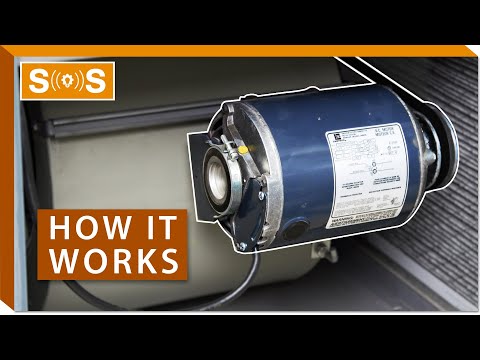
How Do Electric Motors Work?
The Invisible Workhorses of Your Household
Every time you turn on your blender, start a load of laundry, or hear your refrigerator kick on, you are relying on one of the greatest inventions of the modern era: the electric motor. These incredible devices are the muscles of our household appliances, quietly converting electrical energy into physical, mechanical motion. But have you ever stopped to wonder how a flow of invisible electrons from your wall outlet translates into a spinning washing machine drum or a whirring fan blade?
Understanding how electric motors work isn't just a fun physics lesson—it is also incredibly useful for DIY appliance repair. When you know what is happening inside these components, diagnosing a broken dryer, dishwasher, or garbage disposal becomes much easier. Let’s demystify the science behind electric motors and look at the key components that keep your home running.
The Core Principle: Magnetism and Electromagnetism
At the absolute heart of every electric motor is a fundamental law of physics: magnetism. You probably remember playing with magnets as a child and noticing that opposite poles (North and South) attract each other, while like poles (North and North, or South and South) push each other away.
Electric motors harness this natural pushing and pulling force. However, instead of relying solely on natural permanent magnets (like the ones on your refrigerator), motors use electromagnetism. When an electric current flows through a wire, it generates a magnetic field around that wire. By winding that wire into a coil, scientists and engineers can create a powerful temporary magnet—an electromagnet—that can be turned on, turned off, or even have its magnetic poles reversed simply by changing the direction of the electrical current.
Anatomy of a Basic DC Electric Motor
While there are many different types of motors used in household appliances (including AC induction motors and DC brushless motors), they all share similar foundational components. To understand how they interact, it helps to look at a classic brushed DC motor, which contains these primary parts:
- The Stator: This is the stationary outer part of the motor. It typically contains permanent magnets (or static electromagnets) that create a constant magnetic field pointing across the motor’s interior.
- The Rotor (or Armature): This is the central axle that actually spins. It holds the coils of wire (electromagnets) that become magnetized when electricity is applied.
- The Commutator: A clever, split-ring metal collar attached to the spinning rotor. It acts as a rotating switch, constantly reversing the direction of the electrical current in the coils as they spin.
- The Brushes: Small, spring-loaded blocks (usually made of carbon) that press gently against the spinning commutator. They act as the electrical bridge, delivering current from the stationary power source to the moving rotor.
For a beautifully detailed, step-by-step 3D animation of how these parts align and interact, we highly recommend watching this visual demonstration of how electric motors work. Seeing the magnetic fields flip in real-time makes the concept instantly click!
Step-by-Step: How the Rotation Happens
So, how do these parts cooperate to create continuous spinning motion? It happens in a beautifully simple, repeating cycle:
First, electricity travels from your appliance's control board, through the carbon brushes, and into the commutator. From the commutator, the current flows into the coils of wire on the rotor, instantly turning the rotor into an electromagnet.
Because the rotor is now magnetic, its poles interact with the permanent magnets of the stator. The North pole of the rotor is repelled by the North pole of the stator and attracted to the South pole. This magnetic push and pull forces the rotor to begin spinning.
Just as the rotor's North pole reaches the stator's South pole—which would normally cause it to stop and lock into place—the commutator rotates. Because the commutator is split, this rotation flips the direction of the electrical current entering the coils. Instantly, the rotor's magnetic poles reverse. What was once attracted is now repelled, and the rotor is pushed to keep spinning. This cycle repeats thousands of times per minute, producing smooth, continuous rotation.
Electric Motors in Your Household Appliances
Different appliances require different types of motion, which is why manufacturers use specialized motor designs:
Washing Machines: Many modern washers use direct-drive motors or inverter-driven brushless motors. By eliminating the brushes and belts, these motors can precisely control speed and direction, allowing the machine to agitate back and forth or spin at incredibly high speeds to extract water.
Refrigerators: Your fridge relies on a motor inside the compressor to pump refrigerant through the cooling coils. Older fridges used simple on/off motors, while modern, energy-efficient refrigerators use variable-speed linear compressors to maintain a precise temperature with less energy.
Dryers: Clothes dryers typically use a heavy-duty induction motor. This motor performs double duty: it uses a belt to spin the large clothes drum while simultaneously driving a blower fan to circulate hot air through the drum and out the vent.
Signs Your Appliance Motor is Failing
Because motors are mechanical devices with moving parts, they will eventually wear out over years of consistent use. Here are the most common signs that your appliance's motor is on its way out:
- Humming but No Motion: If you turn on your dishwasher or dryer and hear a loud, low humming sound but nothing is spinning, the motor may be seized, or the start capacitor (which gives the motor a kickstart) may have failed.
- A Burning Electrical Smell: Worn-out carbon brushes can create excessive sparking, or the protective insulation on the copper windings can melt, leading to a distinct, acrid burning odor.
- Squealing or Grinding Noises: This usually points to failing bearings inside the motor. When the bearings dry out or deform, the rotor can no longer spin smoothly.
- Tripping the Circuit Breaker: If a motor's internal wiring shorts out, it will draw too much electrical current, instantly tripping your home’s breaker when the appliance tries to start.
Empower Your DIY Appliance Repair
When an appliance stops spinning, clears its throat with a loud hum, or refuses to start, you don't automatically need to buy a brand-new machine. In many cases, replacing a worn-out drive motor, carbon brush set, or start capacitor is a highly manageable DIY project that can save you hundreds of dollars.
By understanding the simple physics of electromagnetism and rotation, you can approach appliance troubleshooting with confidence. If you suspect your motor has reached the end of its lifespan, simply locate your appliance's model number and find the exact OEM replacement motor or components designed for your specific machine.