How to Match an HVAC Motor (In-Depth Guide)
When your heating or air conditioning system stops blowing air, or the outdoor unit begins making a horrific screeching noise, there is a high probability that your HVAC motor has failed. Whether it is the indoor blower motor pushing air through your vents or the outdoor condenser fan motor dispersing heat, a broken motor brings your home comfort to a grinding halt.
Replacing an HVAC motor is a highly manageable DIY project, but there is one major hurdle: finding the correct replacement. You cannot simply buy any motor that looks similar; installing an mismatched motor can lead to electrical failures, poor airflow, or a completely ruined system. This in-depth guide will show you exactly how to match an HVAC motor using the information right on your broken part.
Why Exact Motor Matching is Critical
An HVAC motor is engineered to operate within the precise electrical and physical parameters of your specific furnace, air handler, or condenser. If you install a motor with the wrong horsepower, speed, or rotation, you risk overheating the new motor, damaging your control board, or failing to heat and cool your home efficiently. Matching your motor correctly guarantees system safety, preserves energy efficiency, and protects your investment.
Step 1: Decode the Motor Nameplate
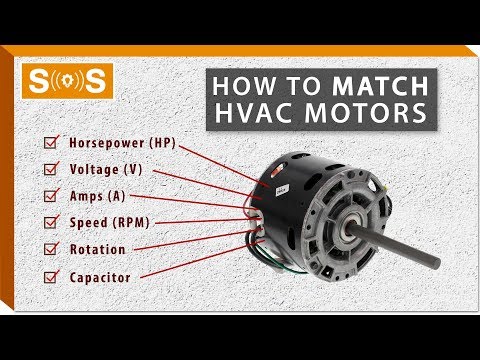
The key to finding a perfect replacement is the metal nameplate or sticker affixed to the side of your old motor. This label is the "Rosetta Stone" of HVAC repair. Before you throw away the old motor, write down or take a clear picture of these critical specifications:
1. Voltage (V): HVAC motors typically run on 115V, 208V, 230V, or 460V. You must match the voltage exactly. Running a 115V motor on a 230V circuit will instantly destroy the motor, while running a 230V motor on a 115V circuit will cause it to hum and fail to start.
2. Horsepower (HP): This measures the motor's power. Common ratings include 1/6, 1/5, 1/4, 1/3, 1/2, 3/4, and 1 HP. You should always match the horsepower of your original motor. Under-sizing will cause the motor to overheat and burn out quickly, while over-sizing can damage your system's blower wheel or fan blades.
3. RPM (Revolutions Per Minute) and Speeds: This indicates how fast the motor spins. Common speeds are 1075 or 825 RPM for condenser fan motors, and 1075 or 1625 RPM for blower motors. Additionally, note if your motor is single-speed or multi-speed (often designated by multiple wire leads for Low, Medium, and High speeds).
4. Amperage (FLA / Amps): Full Load Amps (FLA) represents the amount of current the motor draws under a full load. Your replacement motor's amp rating should be very close to or slightly higher than the original, but never lower.
5. Frame Size (FR): This refers to the physical dimensions of the motor housing. Standard HVAC motor frame sizes are 48 (5.6-inch diameter) and 56 (6.5-inch diameter). If the frame size doesn't match, the motor will not fit into your existing mounting brackets.
Step 2: Determine the Rotation Direction
One of the most common mistakes DIYers make is buying a motor that spins the wrong way. If your condenser fan spins backward, it will pull air into the top of the unit rather than blowing it out, drastically reducing your system's efficiency and potentially damaging the compressor.
Look for the rotation designation on the nameplate, usually written as CW (Clockwise) or CCW (Counter-Clockwise). You must also identify the viewing perspective, which is typically "Lead End" (LE) or "Shaft End" (SE). Many modern replacement motors are "reversible," meaning you can swap two plug-in wires during installation to change the direction of the spin. If you purchase a reversible motor, you can easily match either direction.
Step 3: Measure the Shaft Dimensions
Even if all electrical specifications match, the motor is useless if you cannot mount your fan blade or blower wheel onto it. Measure the shaft of your old motor using a caliper or tape measure:
Shaft Diameter: The standard shaft diameter for residential HVAC motors is 1/2 inch, though 5/8 inch is also common in larger systems.
Shaft Length: Measure from the face of the motor to the very tip of the shaft. If the replacement shaft is slightly longer, it can often be cut down, but a shaft that is too short will not allow the fan blade or blower wheel to align properly inside the housing.
Step 4: Identify the Motor Type (PSC vs. ECM)
You must determine whether your motor is a standard PSC (Permanent Split Capacitor) motor or a modern ECM (Electronically Commutated Motor):
PSC Motors: These are traditional motors that require an external run capacitor to start and run. If you are replacing a PSC motor, you must also purchase a new capacitor that matches the microfarad (µF or MFD) rating listed on the new motor's nameplate. Never reuse an old capacitor with a new motor.
ECM Motors: These are highly efficient, variable-speed brushless DC motors with built-in electronic control modules. ECMs do not use traditional run capacitors. If your motor has a large control module attached to the back, you will need an exact OEM replacement or a specifically programmed universal ECM replacement.
Watch a Step-by-Step Visual Guide
If you want to see exactly how to read these specifications on a real motor and learn some pro-tips for measuring shaft lengths and identifying rotation, watch this helpful video guide:
How to Match an HVAC Motor Video Tutorial
Seeing the physical differences between motor frames and learning how to read the wiring diagrams directly from a technician can save you hours of frustration during your repair project.
Choosing OEM vs. Universal Replacement Motors
When shopping for your replacement motor, you will generally have two options:
OEM (Original Equipment Manufacturer) Motors: These are direct replacements made by or for the brand of your HVAC equipment (such as Carrier, Trane, or Lennox). They will have the exact same mounting brackets, wiring harness, and specifications, making installation incredibly straightforward. However, they are often more expensive.
Universal Motors: Brands like Century, US Motors, and Rescue manufacture highly versatile aftermarket motors. These are designed to replace a wide variety of OEM parts. They often feature multi-horsepower ratings (e.g., a single motor that can be wired to run at 1/3, 1/4, or 1/5 HP) and reversible rotation. Universal motors are cost-effective and readily available, but they may require minor wiring modifications or bracket adjustments during installation.
Summary Checklist for Ordering Your Motor
Before hitting the checkout button on your replacement part, double-check your specs against this quick checklist:
Is the Voltage identical? (115V vs 208-230V)
Is the Horsepower (HP) the same or compatible?
Does the RPM match, and are there enough speed taps?
Is the rotation correct (or is the motor reversible)?
Does the shaft diameter and length match your blower wheel or fan blade?
If it is a PSC motor, did you order a matching new run capacitor?
By taking the time to carefully decode your old motor's nameplate and verify its physical dimensions, you can confidently purchase the correct replacement part, complete your DIY repair safely, and restore comfort to your home.