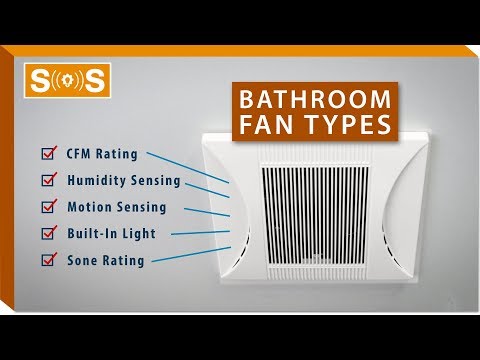
How to Choose a Bathroom Fan
How to Choose the Perfect Bathroom Fan for Your Home
Every time you take a hot shower, your bathroom turns into a temporary rain forest. Without proper ventilation, that lingering moisture can lead to peeling wallpaper, warped cabinetry, ruined drywall, and worst of all, toxic mold and mildew growth. A high-quality bathroom exhaust fan is your home's primary defense against these moisture-related headaches.
However, choosing the right bathroom fan isn't as simple as picking the first model you see on the shelf. You need to balance performance, noise levels, installation requirements, and modern features. In this comprehensive guide, we will break down exactly how to choose the perfect bathroom fan for your space.
1. Understand the CFM Rating (Sizing Your Fan)
The most critical step in choosing a bathroom fan is ensuring it has enough power to clear the air in your specific room. Fan power is measured in CFM, which stands for Cubic Feet per Minute. This measurement tells you how many cubic feet of air the fan can move in one minute.
The standard rule of thumb established by the Home Ventilating Institute (HVI) is simple: you need at least 1 CFM per square foot of bathroom space.
- Small Bathrooms (50 sq. ft. or less): You will need a minimum of a 50 CFM fan.
- Medium Bathrooms (50 to 100 sq. ft.): Match the CFM to the square footage (e.g., an 80 sq. ft. bathroom requires an 80 CFM fan).
- Large Bathrooms (Over 100 sq. ft.): You should calculate CFM based on the specific fixtures in the room. Add 50 CFM for every standard toilet, shower, and bathtub, and add 100 CFM for a jetted whirlpool tub.
If your bathroom has ceilings higher than the standard eight feet, you will need to scale up your CFM rating slightly to account for the extra volume of air in the room.
2. Pay Attention to the Sone Rating (Noise Level)
Have you ever avoided turning on your bathroom fan because it sounds like a jet engine taking off? The noise level of a bathroom exhaust fan is measured in sones. The lower the sone rating, the quieter the fan will be.
Here is a quick breakdown of what to expect from different sone levels:
- 0.5 to 1.0 Sone: Exceptionally quiet. You will barely hear this fan running. This is ideal for master bathrooms where you want a peaceful, spa-like environment.
- 1.5 to 2.0 Sones: Moderately quiet. There is a gentle background hum, but it is not distracting.
- 3.0 to 4.0 Sones: Loud. This sounds like a standard, older exhaust fan. While some people prefer this for added privacy in guest bathrooms, it can be annoying during a long bath or shower.
Keep in mind that ultra-quiet fans (under 1.0 sone) often require larger ductwork to move air efficiently without creating air turbulence noise. Always check the manufacturer's ducting recommendations.
3. Choose the Right Installation Type
Depending on your home’s layout and whether you are replacing an old fan or installing a brand-new one, you have a few configuration options:
Ceiling-Mounted Fans: This is the most common type of bathroom fan. It mounts directly into the ceiling and vents air out through the roof or a side wall via ductwork. This is highly effective because warm, moist air naturally rises.
Wall-Mounted Fans: If your bathroom is on an exterior wall and you do not have attic access above it, a wall-mounted fan is an excellent alternative. It vents directly through the outside wall, eliminating the need for long runs of ductwork.
Inline Fans: For large bathrooms, unique architectural layouts, or situations where you want absolute silence, inline fans are a great choice. The motor is mounted remotely in the attic or crawlspace, connected to the bathroom via ducting. Because the motor is far away, you will only hear the gentle sound of rushing air.
4. Explore Smart and Modern Features
Modern bathroom exhaust fans do much more than just spin a fan blade. Manufacturers now offer a wide array of integrated features designed to make your home more comfortable, energy-efficient, and convenient:
- Humidity Sensors: These fans automatically turn on when they detect a rise in humidity levels and turn off once the air is dry. This is perfect for kids' bathrooms or rental properties where users might forget to flip the switch.
- Built-In Lighting and Nightlights: Many models feature integrated LED light fixtures, saving you ceiling space. Some even include a low-wattage blue or amber nightlight to guide you safely in the dark without waking you up.
- Built-In Heaters: If your bathroom gets chilly in the winter, a fan with an integrated infrared heater or forced-air heater can warm up the room quickly.
- Bluetooth Speakers: For those who love to sing in the shower or listen to the morning news, you can find high-quality fans with integrated, moisture-resistant Bluetooth speakers.
Watch a Step-by-Step Visual Guide
If you are planning to tackle this installation yourself or want to see how these factors translate to a real-world installation, we highly recommend checking out this helpful video guide: How to Install and Choose a Bathroom Exhaust Fan. It provides a visual walk-through of the sizing process, mounting options, and ducting best practices to ensure your new fan operates at peak efficiency.
5. Maintenance, Repair, and Keeping Your Fan Running
Once you have chosen and installed your bathroom fan, regular maintenance is key to keeping it quiet and efficient. Over time, dust, lint, and moisture combine to create a thick grime on the fan blades and grille. This restricts airflow and forces the motor to work harder, which can lead to premature failure.
At least twice a year, remove the plastic grille cover and vacuum away any accumulated dust. Wipe down the blades with a damp cloth if necessary.
If your existing bathroom fan is starting to rattle, squeak, or fail to clear moisture, you might not need to replace the entire unit. Often, a failing motor or a broken blower wheel can be easily replaced. Keeping your fan in top shape ensures your bathroom remains free of mold and moisture damage for years to come.