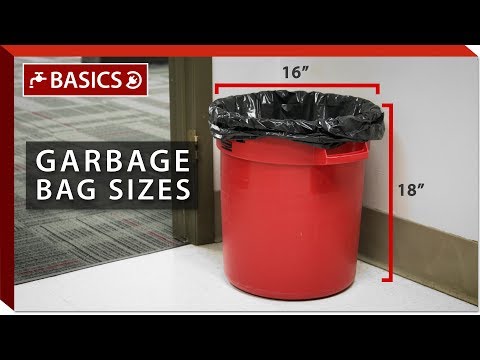
How Do I Perfectly Size a Garbage Bag?
How Do I Perfectly Size a Garbage Bag?
We’ve all been there: you pull a fresh garbage bag from the box, stretch it over the rim of your kitchen trash can, and—snap—it tears. Or worse, you toss in a heavy milk carton, and the entire bag slips inside, dumping coffee grounds and leftovers directly into the bottom of the bin. It’s a messy, frustrating chore that can easily be avoided.
As home maintenance and appliance experts, we know that keeping a clean kitchen starts with the basics. Choosing the right garbage bag size isn't just about avoiding a mess; it also prevents bad odors, deters pests, and extends the lifespan of your trash can or trash compactor. Here is our simple, step-by-step guide to calculating the perfect garbage bag size for any bin in your home.
Why Correct Garbage Bag Sizing Matters
Using a bag that is too small leads to overstretching, tears, and spills that require you to scrub out the inside of your trash can. Conversely, using a bag that is too large is a waste of plastic and money. If you have a built-in trash compactor or a pull-out cabinet bin, an ill-fitting bag can snag on the appliance's internal tracks, leading to mechanical jams and costly repairs. Getting the perfect fit keeps your appliances running smoothly and your kitchen smelling fresh.
Step 1: Measure Your Trash Can
Before you head to the store, you need to grab a tape measure. You will need to take different measurements depending on whether your trash can is round or rectangular.
For rectangular or square trash cans, measure the perimeter of the rim. To do this, measure the width of the front and the depth of the side, add those two numbers together, and multiply by two. For example, if your bin is 12 inches wide and 8 inches deep, the perimeter is 40 inches (12 + 8 = 20, and 20 x 2 = 40).
For round trash cans, you need to find the circumference. Simply measure the diameter (the distance across the top opening of the can) and multiply that number by 3.14 (Pi). For example, if your round can is 12 inches wide, the circumference is roughly 37.7 inches (12 x 3.14).
Finally, measure the height of your trash can from the very bottom to the top rim.
Step 2: Calculate the Perfect Bag Width
Garbage bags are sold flat, meaning the "width" listed on the box is the flat width of the bag when laid on a table, not the diameter of the opening. To find the flat bag width you need, use these simple formulas:
For rectangular cans, divide your perimeter by 2. If your perimeter is 40 inches, you need a bag with a flat width of at least 20 inches.
For round cans, divide your circumference by 2. If your circumference is 37.7 inches, you need a flat bag width of about 19 inches.
If you want to see a visual demonstration of these measurements in action, check out this helpful video guide on sizing a garbage bag. It breaks down the math visually so you can get a perfect fit every time.
Step 3: Calculate the Perfect Bag Height
A bag that is too short will slip inside the bin under the weight of your trash. To prevent this, your bag needs to be tall enough to cover the depth of the can and still have enough material to overhang the rim.
To calculate the required bag height, take the height of your trash can and add 3 to 4 inches for the overhang. Next, add half of the bin's width (for square bins) or half of the diameter (for round bins) to account for the bottom of the bag.
For example, if you have a 20-inch tall square bin that is 12 inches wide, your calculation would be: 20 inches (height) + 4 inches (overhang) + 6 inches (half of the width) = 30 inches. You will want to look for bags that are at least 30 inches tall.
Pro Tips for a Mess-Free Trash Can
Once you have the right size, a few simple tricks can make your trash management even easier. If you still experience minor slipping, consider using a giant rubber band or a trash bag cinch to secure the bag around the rim.
Additionally, if you struggle with suction when pulling a full bag out of the bin, drill a couple of small holes near the bottom of your plastic trash can. This breaks the vacuum seal and allows the bag to slide out effortlessly. Just make sure you only do this on dry-waste bins to avoid leaks!
By taking two minutes to measure your bin, you can save yourself years of spilled trash, wasted money, and unnecessary cleanup. Keep your home running efficiently, and don't let a poorly sized bag ruin your kitchen routine.